
Project details
Client
Nicholson McShane Architects
Value
£703,000
Duration
July 2021 – June 2022
Conditions of Contract
Minor Building Work Contract for Use in Scotland 2016 (incorporating 2018 Amendment 1)
WHK Team
Robert Macnaughton
Fiona Rodden
John Cairns
Building Safety Group Ltd
Client Team
Millar Surveying Services
Clancy Consulting Engineers
Project Benefits
2 Local SME Subcontracted
4 Local Material Suppliers
1 Local Plant Supplier
Overview
This project was delivered in line with Pelagia’s strategic commitment to business growth, providing a modern, efficient, and future-proofed workplace designed to support employees and the company’s expanding global distribution operations. The new facility was developed to enhance both day-to-day functionality and long-term operational resilience.
The works comprised the construction of a new Office and Welfare Building within Pelagia’s live operational depot, located at a busy road junction in Greenock on land formerly occupied by the Tate and Lyle Sugar Refinery. Delivering the project within a constrained and active industrial environment required careful planning, stakeholder coordination, and robust health and safety management to maintain uninterrupted depot operations throughout the build.
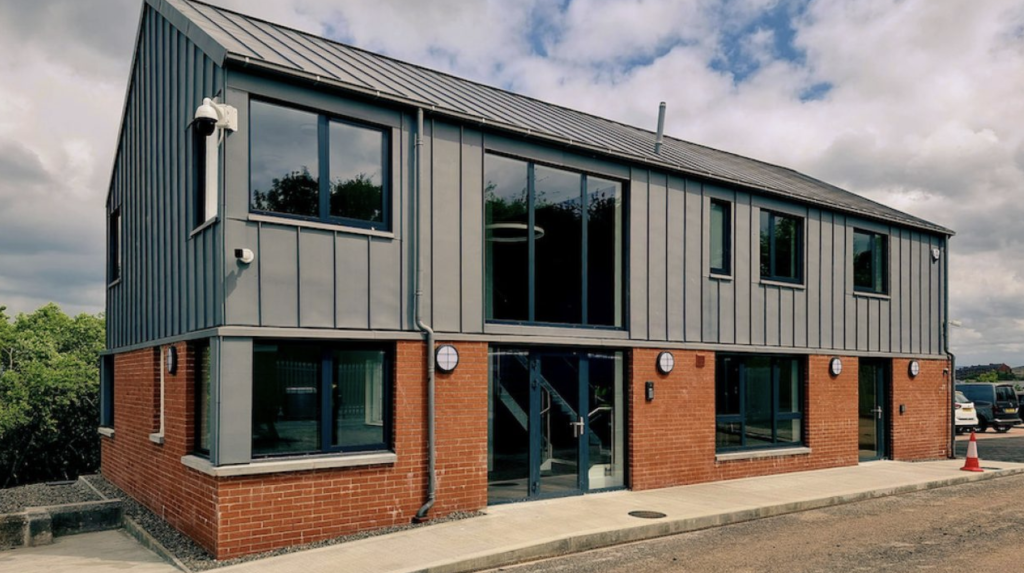
Constructed using traditional building methods, the design placed strong emphasis on sustainability, energy efficiency, and maximising natural daylight, reflecting modern workspace standards. The completed building provides high-quality accommodation including open-plan offices, meeting rooms, laboratory facilities, staff rooms, storage areas, a visitor suite, and comprehensive welfare provision incorporating a canteen, shower facilities, and changing areas. The internal layout was designed to clearly separate visitor and staff areas, supporting both confidentiality and operational efficiency while providing a welcoming front-of-house environment.
The development also prioritised staff wellbeing and accessibility, with modern welfare facilities, improved environmental performance, and flexible spaces capable of adapting to future operational changes. The building design supports efficient circulation, improved working conditions, and enhanced collaboration, aligning with best practice for contemporary office environments seen in comparable public-sector office developments.
Externally, the project included extensive hard landscaping works, the formation of a new car park, and the creation of a new vehicular and pedestrian entrance directly from the main road. These works improved site accessibility, traffic flow, and safety for staff and visitors, while integrating the new building into the wider depot environment.