
Project details
Client
Glasgow Building Preservation Trust
Value
£2.3m
Duration
February 2021 – December 2022
WHK Team
Robert Macnaughton
Fiona Rodden
Alan Binnie
Brian Campbell
Building Safety Group Ltd
Client Team
ARPL Architects
DA Gilmour Ltd
Gardiner & Theobald
FLN Consulting
David Narro Associates
Subcontractors
Kellock Roofing
AKD Electrical
M&D Foundations
Miller Steels
Ventilation
Project Benefits
4 Local SME’s
3 Local Material Supplier
1 Local Plant Supplier
1 New Apprentice
Awards
Civic Trust Awards (2024) Regional Finalist
Overview
Constructed in 1905 by Glasgow Corporation, the Category B Listed West Boathouse is widely recognised as one of the rarest and finest surviving examples of its type in the UK. Occupying a highly prominent riverside location on the banks of the River Clyde, the building sits within an active public park and water-based environment, presenting significant logistical, environmental, and stakeholder management challenges.
Over many years, piecemeal alterations and constrained maintenance budgets had resulted in the building falling into a state of disrepair. In order to secure its long-term future, the project required a comprehensive strip-out to shell condition, allowing the historic structure to be repaired, upgraded, and sensitively adapted to meet modern standards of accessibility, environmental performance, and community use—while retaining its architectural and historic significance.
With the support of Glasgow Building Preservation Trust, whose mission is to protect the city’s most at-risk historic buildings, and funding secured from Historic Environment Scotland, the Heritage Lottery Fund, and other grant bodies, the project progressed to construction.
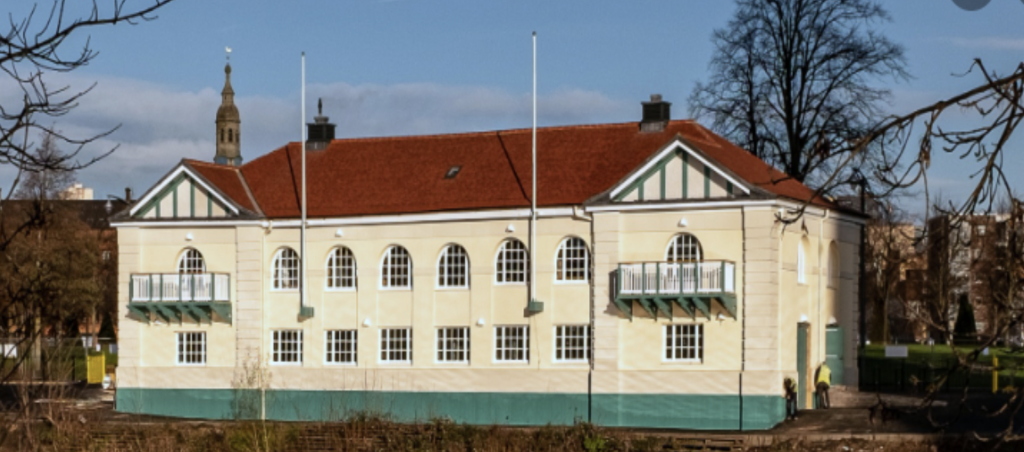
Appointed as Main Contractor, our scope of works included the installation of piled foundations, extensive repair and strengthening of the original timber frame and structure, removal and replacement of external wall cladding, full reroofing works with new rainwater goods, and a comprehensive internal refurbishment. This included upgraded building services, internal reconfiguration to create flexible multi-user spaces, improved facilities for clubs and community groups, and the installation of new pontoons within the River Clyde.
A key complexity of the project was its location within a heavily used public park and event space, which hosts major national events including the annual TRNSMT Music Festival, attracting in excess of 100,000 attendees. Our programme and logistics strategy was developed in close collaboration with Glasgow City Council, Police Scotland and event organisers, allowing works to be carefully sequenced, paused, or reprogrammed to accommodate large-scale events. Temporary demobilisation, adjustment of working areas, and enhanced site security measures were implemented to ensure public safety and uninterrupted event operations, while protecting partially completed works and historic fabric.
Given the building’s riverside setting, environmental protection was a core priority throughout the project. Robust measures were implemented to safeguard the River Clyde and surrounding parkland, including controlled working near the water’s edge, silt and pollution prevention measures, careful management of materials and waste, and protection of existing trees, landscaping, and habitats. Works to the new pontoons were planned to minimise disturbance to river traffic and aquatic life, with close monitoring and compliance with environmental best practice.
Internally and externally, the building was transformed into a fully accessible facility, with new footpaths, widened doorways, ramps, and the installation of a passenger lift ensuring inclusive access for all users. These interventions were carefully detailed to integrate seamlessly with the historic fabric.
The complete redevelopment has successfully reinstated the West Boathouse as a distinctive and celebrated historic timber structure, once again standing proudly on the banks of the River Clyde. The project has secured the building’s future as a vibrant, inclusive hub for water-based activity and community use, while demonstrating our ability to deliver complex heritage works within sensitive environmental settings and alongside major public events.